Skip to content
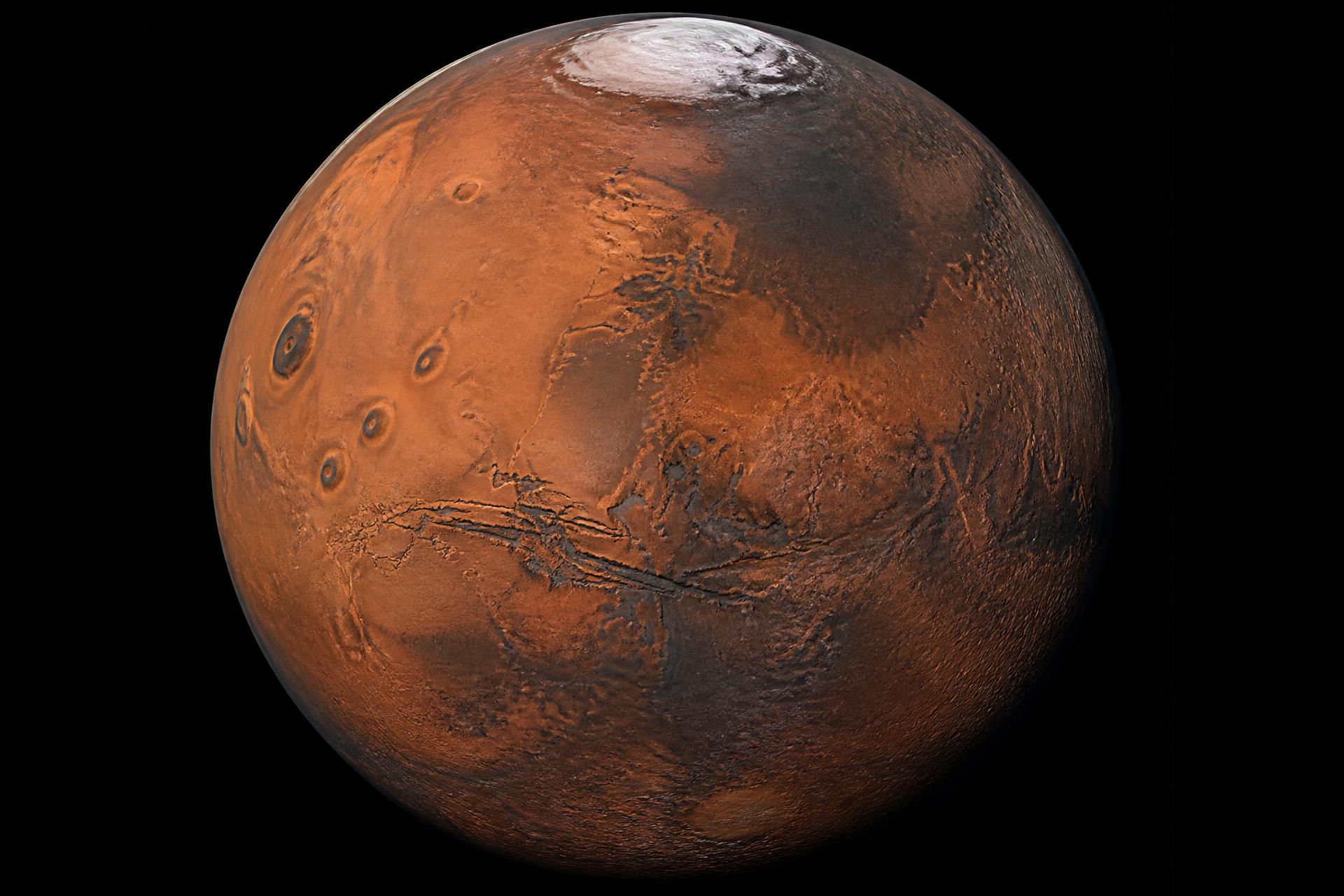
Full disk of Mars against black space, Viking-orbiter global mosaic style
The Cygnus Institute · Constraint Analysis 001

The Cygnus Institute Constraint Analysis 001: Terraforming Mars

Mars can be madewarm and wet.
It cannot be made breathablewithout importing a nitrogenocean from Saturn.

A first-principles feasibility analysis of planetary terraforming. Every figure derived. Every objection answered. Our weakest number named.

§01The Verdict

Mars is two projects, not one.

A warm, wet, microbially-inhabited Mars is a sub-Type I project, achievable by a civilization only modestly beyond our own, on a timescale of decades to centuries.

An open-air, human-breathable Mars is a Kardashev Type I undertaking: sustained ~2×10²⁶ J of directed work held stable for 600+ years, longer than any civilization has yet existed.

The barrier is not cleverness. It is two brute facts: Mars lacks the accessible CO₂ to build pressure, and it lacks the nitrogen to build breathable air. Oxygen is easy; the buffer gas it must be mixed into is not.

Atmosphere required per millibar of surface pressure
3.88×10¹⁵ kg
Regolith to process for nitrogen. The entire crust of the planet.
~2.3×10²² kg
Sunlight Mars already intercepts, exceeding Kardashev Type I
2.11×10¹⁶ W
§02The Decoupling

Three problems, not a chain.

The standard roadmap is sequential: release CO₂, warm and pressurize, convert CO₂ to oxygen, breathe. The arithmetic does not support that structure. Three problems treated as one chain are largely separable.

ProblemPhysical quantityBinding constraintCoupling
ThermalRadiative forcing (W/m²)Control authority + maintenanceWeak, needs almost no mass
PressureGas inventory (kg)Endogenous CO₂ ceiling ~20 mbarModerate
CompositionpO₂, pN₂, pCO₂Nitrogen importWeak, O₂ comes from water, not CO₂
Interactive · Iteration 04
TOOL PENDING
Decoupling Diagram

Interactive triangle of Thermal, Pressure, and Composition nodes. Edge weight encodes coupling strength; hovering a node reveals its binding constraint. Ships in Iteration 4.

You can have a warm, wet, biologically active Mars without solving the pressure problem. What you cannot have, without moving mass between planets, is breathable air.
§03Foundations

Four constants. Everything follows.

Everything descends from four measured quantities and the hydrostatic relation. Nothing requires trusting a citation.

Mars mean radiusR = 3.3895×10⁶ m
Surface areaA = 4πR² = 1.444×10¹⁴ m²
Surface gravityg = 3.721 m/s²
Solar constant at 1.524 AUS = 586 W/m²
Derived
m = P·A / g = 3.88×10¹⁸ kg / bar = 3.88×10¹⁵ kg / mbar

Cross-check: independently published value 3.89×10¹⁵ kg/mbar. Agreement to 0.3%.

Intercepted solar power
πR² × 586 = 2.11×10¹⁶ W

Absorbed at albedo 0.25 ≈ 1.6×10¹⁶ W.

Present inventory (kg)
Total atmosphere · 2.33×10¹⁶
CO₂ · 2.25×10¹⁶ · Carbon · 6.1×10¹⁵
N₂ · 3.9×10¹⁴ · Ar · 4.1×10¹⁴
Mars north polar ice cap swirling spiral pattern from orbit
Constraint I · Thermal

Warming is notan energy problem.

§04Constraint I · Thermal
Requirement

Mars surface ≈ 210–218 K. Melting point 273 K. Need +55–63 K for global melt, +30 K for seasonal meltwater.

Framing

Mars absorbs ~1.6×10¹⁶ W for free. Warming is a control problem: modulating a flux that already arrives. That is why warming costs megatons while pressure costs exatons.

Mechanisms, ranked

  1. 01
    Engineered IR-active aerosols

    ~9 μm conductive nanorods from Martian dust; ~30 L/s sustained, 10-yr lifetime → ≳30 K global warming; ~5,000× more mass-efficient than the best greenhouse gases; processes ~2×10⁷ m³/yr.

  2. 02
    Silica aerogel solid-state greenhouse

    A 2–3 cm layer transmits photosynthetic light, blocks UV, raises subsurface above 273 K with no heat source. The near-term-realistic option.

  3. 03
    Perfluorocarbon super-greenhouse gases

    Thousands× CO₂ forcing, century-to-millennium lifetimes. Limited by Martian fluorine and 10⁶–10⁹ t/yr throughput.

  4. 04
    Orbital reflectors

    ~125 km radius, ~2×10⁵ t, +5 K poleward of 70° S. Statite station-keeping.

Every warming mechanism is maintenance-limited. Aerosols sediment. Gases photolyse. Mirrors drift. There is no set-and-forget state. Warming is a permanent operating expense.
Thin Mars atmosphere seen edge-on against black space
Constraint II · Pressure

There is not enoughcarbon dioxide.There never was.

§05Constraint II · Pressure
The Jakosky ceiling

All accessible CO₂ (polar caps ~4–12 mbar, adsorbed regolith, exposed carbonates) totals ≈ 3× the present atmosphere, or ~18–20 mbar. Holding 1 bar as carbonate would need a global carbonate layer ~15 m thick, which is not observed.

The Armstrong limit

20 mbar does not reach 62.7 mbar, below which body-temperature water boils. Pressure suits remain mandatory. Endogenous CO₂ cannot even release humans from a suit.

Total accessible CO₂ (Jakosky 2018)
~20 mbar
Armstrong limit, body-temperature water
62.7 mbar
Global carbonate layer thickness required for 1 bar
~15 m
Because carbon disposal is a 3.5-million-year problem, a thick CO₂ atmosphere is not merely blocked by inventory. It is the wrong objective. A liability you pay to create and pay again to destroy.
Exposed water ice scarp cutting through Martian regolith
Constraint III · Oxygen

Oxygen comes from water.Mars has enough water.

§06Constraint III · Oxygen
Requirement (alveolar gas equation)
pO₂,alv = 0.21 × (1013 − 47) − 50 = 153 mbar
Target: ≥ 130 mbar minimum, ~160 mbar comfortable
Mass required
160 mbar × 3.88×10¹⁵ = 6.2×10¹⁷ kg O₂
= 1.94×10¹⁹ mol
Route: 2 H₂O → 2 H₂ + O₂
Requires 7.0×10¹⁷ kg water ≈ 4.8 m global equivalent layer.

Against 20–40 m accessible. 15–25% of the inventory. The water exists.

The CO₂ shortfall everyone leads with does not block oxygenation. It blocks pressure.
Energy floor
1.94×10¹⁹ mol × 572 kJ/mol = 1.11×10²⁵ J
At 60% electrolysis efficiency ≈ 1.9×10²⁵ J
At Type I power (10¹⁶ W): ~35 years of output
MOXIE (Perseverance) caveat

MOXIE produced 122 g total, ~12 g/hr peak on ~300 W. Extrapolating a demonstrator to 10¹⁸ kg is not informative; the energy floor is the meaningful statement.

Interactive · Iteration 01
TOOL PENDING
Atmosphere Builder

Two sliders (total pressure, O₂ fraction). Live derivation of atmospheric mass, O₂/N₂ partial masses, water required in metres of global equivalent layer, alveolar pO₂ with verdict, and N₂ as a fraction of Titan's atmosphere. Ships in Iteration 1.

Layered Martian terrain and dark barchan dunes from orbit
Constraint IV · Carbon Disposal

The carbon has togo somewhere.

§07Constraint IV · Carbon Disposal

If you built a 1 bar CO₂ atmosphere, how much carbon must you later remove?

1 bar CO₂ = 3.88×10¹⁸ kg → C = 1.06×10¹⁸ kg = 7,340 kg C / m²

The shortfall, in Earth reservoirs

ReservoirCarbon (kg)Shortfall vs. Mars
Earth living biomass (~550 Gt C)5.5×10¹⁴1,900× short
Earth biomass + soil carbon (~2,500 Gt C)2.5×10¹⁵420× short
Earth ocean dissolved inorganic carbon (~38,000 Gt C)3.8×10¹⁶28× short
Mars requirement (1 bar CO₂)1.06×10¹⁸reference
Rate, at Earth's burial rate

Rate is the killer. CA-001 applied Earth's bulk silicate weathering rate and obtained 3.5 million years. Using the Mars-specific sequestration rate measured by Kite et al. (2025), 1×10⁻⁴ mbar/yr or 0.106 Gt C/yr, the correct figure is ~10 million years. Two independent methods converge: weathering-front advance at terrestrial rates gives 0.9 to 8.9 million years. The earlier number was optimistic by roughly a factor of three.

Ocean absorption

Even at 100× Earth's dissolved-carbon concentration, a Mars ocean falls ~90× short of the required 1.06×10¹⁸ kg.

Skip the thick-CO₂ stage entirely. Warm with aerosols. Make oxygen from water. Import buffer gas. Never build an atmosphere you must later dismantle.
Cassini image of Saturn's moon Titan as a full orange haze globe
Constraint V · Nitrogen

The wall is nitrogen.The only depotis Titan.

§08Constraint V · Nitrogen · Centerpiece

Two target atmospheres bracket the problem: a Denver-equivalent minimum, and Earth-identical.

TargetTotal PpO₂pN₂N₂ mass
Denver-equivalent minimum570 mbar160 mbar (28%)400 mbar1.55×10¹⁸ kg
Earth-identical1013 mbar213 mbar (21%)780 mbar3.03×10¹⁸ kg
Martian supply
Atmospheric N₂ = 3.9×10¹⁴ kg
Deficit factor: ~4,000×
Crustal nitrate (Gale, SAM)
70–1,100 ppm NO₃ · mid-estimate 300 ppm
→ 68 ppm elemental N
To obtain 1.55×10¹⁸ kg N from crust
You would processthe entire crustof the planet.
Process 2.3×10²² kg regolith (mid-estimate)
Martian crust ≈ 2.2×10²² kg
Even at 1,100 ppm NO₃ high-end: ~28% of the crust.
Titan, the depot
Atmosphere · 9.06×10¹⁸ kg
~95% N₂ · ~8.6×10¹⁸ kg
Fraction of Titan required
Denver-equivalent: 18% of Titan's atmosphere
Earth-identical: 35%

Δv ladder · Titan surface → Mars

StageΔv (km/s)
Titan escape2.64
Saturn escape from Titan's orbit2.31
Heliocentric transfer 9.58 → 1.52 AU4.59
Mars arrival (aerocapture)~0
Total~9.5
Interactive · Iteration 03
TOOL PENDING
Δv Ladder (animated)

Staged stack animation with sequential draw-in per leg, count-ups accumulating to 9.5 km/s, and a linked energy-floor readout. Ships in Iteration 3.

Energy floor
½ · 1.55×10¹⁸ · (9.5×10³)² = 7.0×10²⁵ J (ideal)
At 30–50% propulsion efficiency ≈ 1.5–2.3×10²⁶ J
This single term dominates the entire energy budget, an order of magnitude larger than oxygenation. The cost of Mars is the cost of hauling nitrogen across eight astronomical units.
§09Coupled Failure Modes

What the simple story leaves out.

01OPEN
Global dust storms vs. aerosol warming

Planet-encircling dust events every 3–4 Mars years (the 2018 event ended Opportunity). Suspended dust warms air aloft while cooling the surface: the opposite sign to the intended forcing. You would inject an engineered aerosol into an atmosphere already performing uncontrolled planetary-scale aerosol injection. Scavenging, coagulation, and dust-event reversal unresolved.

02REFUTED BY CA-002
The sulfate–carbonate conflict

Tested and refuted. Mars is sulfate-rich and carbonate-poor, and Meridiani jarosite records pore water below pH 4. CA-001 inferred that a wet Mars would therefore produce acidic brine hostile to carbonate, placing the carbon-burial pathway in chemical conflict with the natural chemistry of a wet planet. Constraint Analysis 002 tested that inference directly and found it false by a wide margin. The observed acidity is an artifact of low water-to-rock ratio and does not survive dilution to ocean scale. See Constraint Analysis 002 below.

03STRUCTURAL
Obliquity chaos

Lacking a large moon, Mars's axial tilt wanders chaotically from ~0° to >60° over 10⁵–10⁷ years. Any terraformed state is metastable, requiring permanent active management. It forecloses the word 'permanent.'

§10Retention & Radiation

Two objections weaker than they look.

Escape is not a showstopper

MAVEN: present loss ~100 g/s ion escape, ~2–3 kg/s combined. An engineered thick atmosphere depletes over 10⁷–10⁸ years. Irrelevant on any engineering horizon. A magnetosphere is not required to retain gas.

Radiation is solved by the atmosphere itself

Curiosity/RAD: 0.64 mSv/day at the surface under ~21 g/cm² of column. A 1 bar atmosphere provides ~1,000 g/cm², Earth's value. The mature end-state is self-shielding. A 1–2 T magnetic shield at Mars–Sun L1 matters only during transition and remains concept-level.

Mars crescent limb backlit by the Sun
Placement

Mars already interceptsmore power than a Type Icivilization commands.

§11The Kardashev Placement
Energy budget
Nitrogen import · 1.5–2.3×10²⁶ J
Oxygen · 1.9×10²⁵ J
Ice melting · ~2×10²⁴ J
Warming · ~0
Total ≈ 2×10²⁶ J
Reference
Kardashev Type I · 10¹⁶ W
Humanity today · ~2×10¹³ W · K ≈ 0.73

Time to completion, by power level

At 10¹⁶ W (Type I)
~630 yr
At 10¹⁵ W
~6,300 yr
At humanity today (2×10¹³ W)
~320,000 yr

Terraforming is not about generating energy. It is about redirecting a flux that already arrives (cheap) and paying irreducible chemical and transport work: breaking O–H bonds and hauling nitrogen across the solar system (expensive).

Interactive · Iteration 02
TOOL PENDING
Kardashev Dial

Logarithmic power slider 10¹³ → 10¹⁷ W with live Kardashev level and time-to-completion in monumental mono. Ticks for humanity today, Type I, and Mars's own insolation. Ships in Iteration 2.

Wide panorama of the Martian surface from a rover
Roadmap

Seven phases.One of them isirreversible.

§12The Roadmap
PhaseObjectiveGateTimescaleK
0Prospecting: ice, global nitrate survey, sulfate/pH mapping, dust–aerosol studyInventories characterizedto ~20400.73
IParaterraforming: aerogel greenhouses, ISRU, perchlorate remediationSelf-sustaining habitats2030s–21000.75
IIThermal: aerosol/mirror forcing to +30 KSeasonal meltwaterdecades0.80
III-aHydrosphere + acidophile ecopoiesis (must precede III-b)Self-propagating biospherecenturies0.85
III-bOxygen via water electrolysis (must follow III-a)pO₂ rising, H₂ venting stablecenturies0.90
IVNitrogen import from Titan1.5×10¹⁸ kg delivered~600 yr at Type I1.00
VComposition closure: pCO₂ < 10 mbar, ozone, obliquity managementShirtsleevemillennia1.00
Sequencing constraint, CA-002

Iron supplies 42% of the divalent cations available for carbonate formation. Oxygenation converts Fe(II) to insoluble Fe(III) oxide and removes it permanently from the carbon-burial budget. Carbon buried under anoxia can use the iron pathway. Carbon buried afterward cannot. These phases were specified as parallel. They are not. Burial must be run to completion first.

Phases 0–III are individually valuable and reversible. Phase IV is the irreversible commitment, and the true decision point.
Interactive · Iteration 05
TOOL PENDING
Interactive Roadmap Timeline

Horizontal axis Phase 0 → V with III-a and III-b splitting into parallel tracks that rejoin. Rising Kardashev line beneath. Click a phase for detail (objective, gate, timescale, off-ramp). Phase IV marked distinctly in oxide. Ships in Iteration 5.

§13Objections

What the strongest critics say.

Obj. 01PARTIAL
There isn't enough CO₂.

Correct, and conceded, for pressure. It does not block oxygenation; oxygen comes from water.

Obj. 02ANSWERED
Oxygenation takes 100,000 years.

True biologically. False industrially. Energy floor ~10²⁵ J, ~35 years at Type I power. Timescale is set by available power, not biology.

Obj. 03ANSWERED
Escape makes it futile.

Wrong by 5–6 orders of magnitude. 10⁷–10⁸ years.

Obj. 04ANSWERED
You need a magnetosphere first.

No. The atmosphere is self-shielding. Transitional concern only.

Obj. 05CONCEDED
O'Neill cylinders dominate.

Largely conceded. Free-space habitats deliver 1 g, full radiation control, more usable biomass per joule. The strongest strategic objection, and partial gravity sharpens it.

Obj. 06OPEN
Dust storms wreck aerosol schemes.

Open problem, not resolved. We do not oversell the aerosol result.

Obj. 07ANSWERED
Any end-state is unstable.

Metastable on 10⁵–10⁷ years. Requires permanent management; does not preclude the project.

Obj. 08OPEN
Planetary protection forbids it.

Live and unresolved. Category IV constraints and possible extant life are real; some ethical positions permit terraforming only for a lifeless Mars. Conceded as unresolved.

Interactive · Iteration 06
TOOL PENDING
Objection Cards (flip)

Cards flip to reveal responses; the visible balance of CONCEDED to ANSWERED serves as the credibility engine. Ships in Iteration 6.

§14Open Problems

The institute's active research directions.

  1. 01
    The sulfate–carbonate incompatibility, quantified.

    No published treatment models carbon-sequestration capacity in a Mars ocean whose pH is set by the observed sulfate inventory. Tractable with standard geochemical codes and measured SO₃ abundances.

    CLOSED. See Constraint Analysis 002 below. The answer is that no incompatibility exists at ocean scale, and that a different and previously unstated constraint takes its place.

  2. 02
    Aerosol warming under planet-encircling dust events.

    Interaction of engineered particles with global dust storms is not closed.

  3. 03
    Hydrogen-escape flux as a rate limit on oxygenation.

    The water route vents 7.8×10¹⁶ kg H₂. Whether Jeans escape can carry that flux, or whether H₂ accumulates to hazardous fractions, sets a maximum oxygenation rate. Uncomputed.

  4. 04
    Nitrogen logistics as a mission-design problem.

    Optimized low-thrust trajectories and Titan atmospheric-mining architectures are open engineering territory.

  5. 05
    Partial-gravity biology.

    Below ~0.4 g, human musculoskeletal and cardiopulmonary health may be unmaintainable long-term, with no known countermeasures, and no reproduction data at any partial gravity. The one blocker terraforming cannot address at all.

Layered, sulfate-bearing Martian terrain in close range
The Cygnus Institute · Constraint Analysis 002 · Preprint

Constraint Analysis 001predicted sulfate wouldclose the carbon pathway.

We tested our own claim.It is wrong.
The real constraint is thatoxygen and carbon competefor the same iron.

An original geochemical analysis. Model validated against published benchmarks. Code and figures released.

§15Constraint Analysis 002 · The Refutation

The acid problem is not real.

The test is a mass balance between the acid stored in Martian sulfate and the acid-neutralizing capacity of the basalt beneath it. Only Fe(III)-sulfate carries stored acidity. Calcium and magnesium sulfates are already charge-balanced by cations previously leached from basalt, so dissolving them changes nothing.

Acid-neutralizing capacity of Martian basalt
8.02 eq/kg
Maximum stored acidity of observed sulfate, all as Fe(III)
1.50 eq/kg
Margin. The system is net alkaline under every parameter tested
5.3×
TestResult
SO₃ required to block carbonate, all as Fe(III)-sulfate42.8 wt%
SO₃ actually observed in Martian soil5 to 8 wt%
Shortfall of the observed inventory against the blocking threshold~7×
A regolith composed entirely of jarosite6.00 eq/kg vs basalt's 8.02
Calcite saturation index across the dilute regimeSI +2.9 to +5.6, supersaturated
Even a regolith made entirely of jarosite cannot acidify a Martian ocean past the buffering capacity of the basalt beneath it.

Mars looks acidic because its water-to-rock ratio has always been tiny. A thin reaction rind dissolves its soluble sulfate completely while the silicate beneath contributes almost none of its buffering capacity, and acid wins locally. Hurowitz et al. (2006) identified exactly this mechanism for observed Mars. Ocean-scale water-to-rock ratio inverts it. The mineralogy is evidence about the regime Mars has occupied, not the regime terraforming would create.

Constraint Analysis 002 · The Real Constraint

The iron problem.

Carbonate precipitation consumes divalent cations. Martian basalt supplies calcium at 1.236, magnesium at 2.248, and iron at 2.533 mol/kg. Iron is the most abundant of the three, and ancient Martian carbonate is dominantly siderite, FeCO₃. Under an oxygenated atmosphere, dissolved Fe(II) oxidizes within seconds at circumneutral pH and precipitates as ferric oxide. It is then permanently unavailable.

Depth of crust weathered per bar CO₂ · log scale
Anoxic · Ca + Mg + Fe5.27 mol/kg
46 m
Oxic · Ca + Mg2.73 mol/kg
89 m
Oxic, magnesite inhibited · Ca only0.49 mol/kg
503 m
Share of the carbonate cation budget supplied by iron, lost on oxygenation
42%
The oxygenation that makes Mars breathable destroys 42% of its carbon burial capacity.
Constraint Analysis 002 · Scaling

The cost of the atmosphere you choose to build.

CO₂ removedAnoxicOxic (Ca+Mg)Oxic (Ca only)
10 mbar0.46 m0.89 m5.0 m
100 mbar4.6 m8.9 m50 m
1000 mbar46 m89 m502 m
Drawing a 20 mbar endogenous atmosphere below the breathability ceiling requires weathering about one metre of crust. Removing a full bar requires 89 to 503 metres and ten million years. This is the second independent argument against building a thick CO₂ atmosphere.
Methods and limitations

Model. Plummer & Busenberg (1982) carbonic acid and calcite constants, Millero (1995) for K_w, Davies activity coefficients, proton-promoted basalt dissolution kinetics after Gislason & Oelkers (2003). Composition: Taylor & McLennan (2009) average Martian crust, with Rocknest soil as sensitivity end-member. No fitted parameters.

Validation. pK₁ 6.352 against 6.35. pK₂ 10.329 against 10.33. Calcite-saturated water at pCO₂ 10⁻³·⁵: model gives 0.485 mmol/kg Ca and pH 8.28, against textbook 0.50 and 8.3.

Limitations, stated. Davies is reliable to ionic strength 0.5 mol/kg. Benchmarked against seawater the model overestimates pH by ~0.3 units, so all quantitative pH claims here are restricted to the dilute regime and the concentrated magnesium-sulfate brine regime requires a Pitzer treatment. This is the largest methodological gap. Batch equilibration stands in for reactive transport. Magnesite kinetics are bounded, not modeled. Redox is imposed, not computed.

Status. Preprint. Not peer reviewed. [DOI PLACEHOLDER, insert when deposited.]

§16Data Room

Uncertainty register.

QuantityValueUncertaintySensitivity
kg per mbar3.88×10¹⁵<1%Low
Accessible CO₂~20 mbar~2×High
Regolith nitrate300 ppm NO₃~15×Very high
Accessible water20–40 m GEL~2×Low
Titan N₂8.6×10¹⁸ kg<10%Low
Δv Titan→Mars9.5 km/s±20%Moderate
Propulsion efficiency30–50%speculativeHigh
Aerosol warming+30 K at 30 L/smodel-dependentHigh
The weakest number in this analysis. It rests on a single crater. A global nitrogen survey is the highest-value measurement in Phase 0.

References

  • Ansari et al. 2024 · Science Advances
  • Jakosky & Edwards 2018 · Nature Astronomy
  • Wordsworth, Kerber & Cockell 2019 · Nature Astronomy
  • McKay, Toon & Kasting 1991 · Nature
  • Turyshev 2026 · arXiv:2603.00402 · APS Open Science
  • Kite et al. 2026 · arXiv:2604.02242
  • DeBenedictis et al. 2025 · Nature Astronomy
  • Richardson et al. 2026 · GRL
  • Stern et al. 2015 · PNAS
  • Hassler et al. 2014 · Science
  • Laskar & Robutel 1993 · Nature
  • Green et al. 2017 · LPI
  • Sparrow 1999 · Environmental Ethics
  • Bar-On, Phillips & Milo 2018 · PNAS
  • Zubrin & McKay 1993 · AIAA
  • McKay & Marinova 2001 · Astrobiology
§17About

The Cygnus Institute.

The Cygnus Institute conducts first-principles feasibility analysis of planetary-scale engineering. It publishes numbered constraint analyses that derive every figure from measured quantities, answer every serious objection, and name their own weakest assumptions. Constraint Analysis 001 · 002 is the terraforming of Mars.